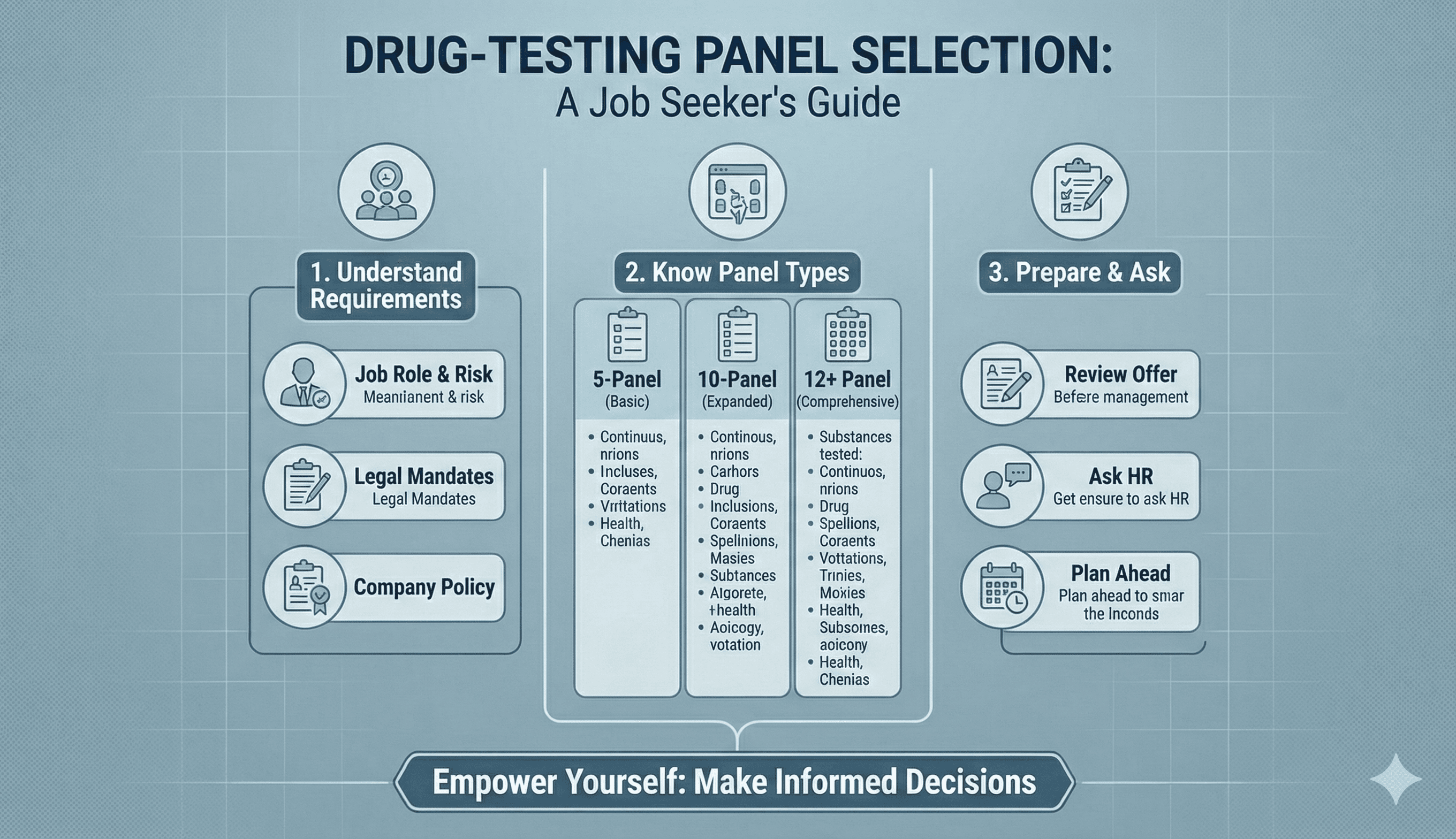
If you were recently hired at a new job, you may be required to submit a drug test. The panel your employer orders depends on the role, the industry, and whether the company follows a regulatory program or an internal policy. This guide summarizes the most common panel combinations and what each additional panel typically adds.
A “panel” is simply a predefined set of substances screened together. Higher-number panels generally add more drug classes beyond a standard baseline. Employers can customize panels, so it is helpful to ask HR for the panel code/name (not only the number), because “10-panel” can vary by vendor.
(Tip: if you take prescriptions, have your prescription info available for the Medical Review Officer (MRO) process, if one is used.)
Typical panel progression (4–12)
The table below shows a common lineup used for urine testing. Treat it as a rule-of-thumb rather than a universal standard.
| Drug / Class | 4 | 5 | 6 | 7 | 8 | 9 | 10 | 11* | 12 |
|---|---|---|---|---|---|---|---|---|---|
| THC (Marijuana) | ✓ | ✓ | ✓ | ✓ | ✓ | ✓ | ✓ | ✓ | |
| Cocaine | ✓ | ✓ | ✓ | ✓ | ✓ | ✓ | ✓ | ✓ | ✓ |
| Opiates (e.g., morphine, codeine) | ✓ | ✓ | ✓ | ✓ | ✓ | ✓ | ✓ | ✓ | ✓ |
| PCP | ✓ | ✓ | ✓ | ✓ | ✓ | ✓ | ✓ | ✓ | ✓ |
| Amphetamines | ✓ | ✓ | ✓ | ✓ | ✓ | ✓ | ✓ | ✓ | ✓ |
| Benzodiazepines | ✓ | ✓ | ✓ | ✓ | ✓ | ✓ | ✓ | ||
| Barbiturates |